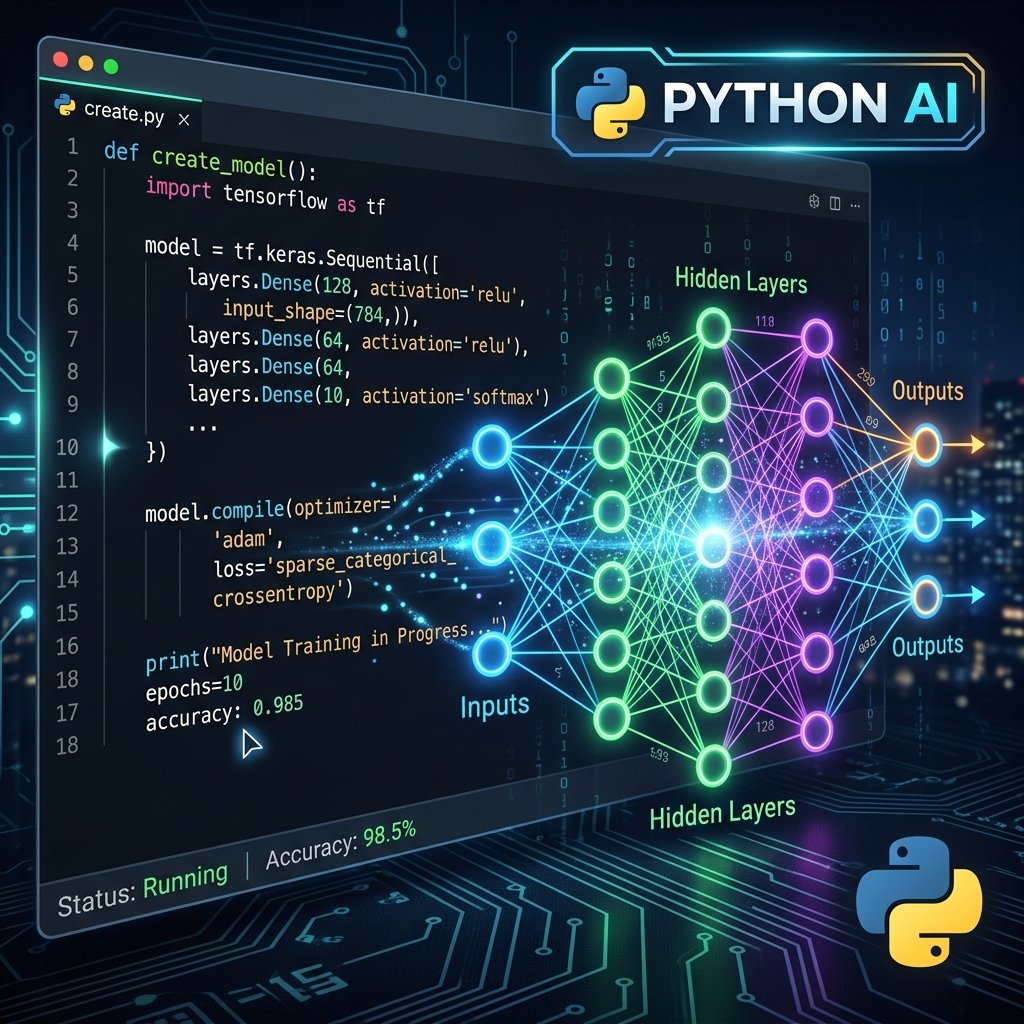
The Language of the Future
Artificial Intelligence (AI) and Machine Learning (ML) are transforming every industry, from healthcare to finance. At the heart of this revolution is a programming language that was created over 30 years ago: Python.
Why did a language famous for its simplicity become the powerhouse behind the most complex AI models in the world?
Why Python Dominates AI
- Readable and Simple Syntax: Python reads almost like plain English. This allows data scientists and researchers to focus on solving complex mathematical problems rather than wrestling with complicated syntax.
- The Ecosystem of Libraries: Python's true strength lies in its massive open-source community. There is a pre-built library for almost everything in AI.
- Platform Independence: Python runs on Windows, macOS, and Linux, making it highly versatile for deploying models to cloud servers.
The Core Python AI Stack
If you want to get into AI and Machine Learning, you need to master this specific stack of Python libraries:
- NumPy: The foundational library for numerical computing. It handles large, multi-dimensional arrays and matrices.
- Pandas: The ultimate tool for data manipulation and analysis. Think of it as Excel on steroids.
- Scikit-Learn: The go-to library for traditional machine learning algorithms (regression, classification, clustering).
- TensorFlow & PyTorch: The heavyweights of Deep Learning. These libraries are used to build neural networks for image recognition, natural language processing (like ChatGPT), and self-driving cars.
Your Roadmap to Python AI
Don't jump straight into building neural networks. Start by mastering core Python concepts (loops, functions, dictionaries). Then, learn Pandas to manipulate data. Once you are comfortable handling data, learn the math behind simple linear regression and implement it using Scikit-Learn. AI is a marathon, not a sprint, and Python is the best vehicle for the journey.